

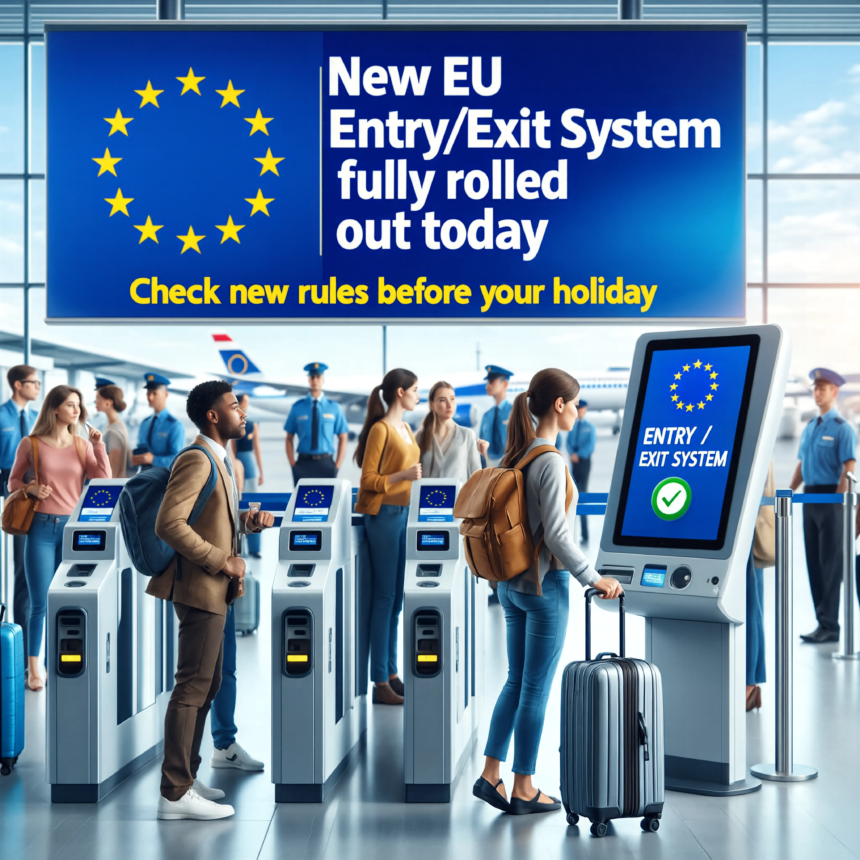
🇪🇺 What’s Changed? The EU Entry/Exit System Is Now Live
This major border modernization affects all non-EU nationals—including UK, US, Canadian, Australian, and other visa-exempt travelers—entering the Schengen Area for short stays.
The EES is a digital border management system that records your biometric data (facial image and fingerprints), passport details, and exact entry/exit dates electronically
No more faded ink stamps—your travel history is now stored securely in an EU-wide database operated by eu-LISA
Key takeaway: If you’re a non-EU citizen traveling to Europe for tourism, business, or family visits under 90 days, you’ll now undergo biometric registration at border control. Allow extra time for your journey.
🧭 Who Does the EES Apply To?
✅ Short-stay Schengen visa holders (up to 90 days within any 180-day period)
❌ Exempt travelers: EU citizens, EEA/Swiss nationals, and those holding long-stay visas or residence permits in a Schengen country
Austria, Belgium, Bulgaria, Croatia, Czechia, Denmark, Estonia, Finland, France, Germany, Greece, Hungary, Iceland, Italy, Latvia, Liechtenstein, Lithuania, Luxembourg, Malta, Netherlands, Norway, Poland, Portugal, Romania, Slovakia, Slovenia, Spain, Sweden, and Switzerland.
🔐 How the EES Works: Step-by-Step for Travelers
First-Time Entry Under EES
- Approach the border control point (airport, ferry terminal, or land crossing)
- Present your passport to a border officer or self-service kiosk
- Provide biometric data:
- Facial image capture (via camera)
- Fingerprint scan (all 10 fingers)
- Verify personal details: Name, date of birth, passport number, and travel purpose
- Receive digital confirmation of entry—no physical stamp required
Many major ports now feature self-service pre-registration kiosks to speed up the process, especially at Eurostar (London St Pancras), Eurotunnel (Folkestone), and Dover
www.gov.uk
Returning Travelers: Faster Processing
If you’ve already been registered in EES, subsequent entries are quicker. Border guards simply verify your stored biometrics against your passport—often in under 60 seconds.
Exit Procedures
You may also be asked to provide biometric verification when leaving the Schengen Area. This ensures accurate tracking of your stay duration and compliance with the 90/180-day rule
⏱️ What This Means for Your Holiday: Practical Tips
✅ Allow Extra Border Time
During initial rollout, expect longer processing times—especially at busy airports like Paris CDG, Amsterdam Schiphol, or Frankfurt. The UK government advises travelers to “be prepared to wait longer than usual at the border”
✅ Know the 90/180-Day Rule
✅ Data Privacy & Retention
✅ No Pre-Registration Required
Unlike the upcoming ETIAS system (launching late 2026), EES requires no advance application or fee
Registration happens only at the border—no online forms, no €20 charge.
⚠️ Beware of scams: Any website claiming to sell “EES registration” is fraudulent. Official information is available only via europa.eu or your national government site.
🌍 EES vs. ETIAS: Don’t Confuse the Two
|
Feature
|
EES (Entry/Exit System)
|
ETIAS (Travel Authorization)
|
|---|---|---|
|
Launch Date
|
✅ Fully operational April 10, 2026
|
🔄 Expected late 2026 home-affairs.ec.europa.eu
|
|
Purpose
|
Tracks entries/exits at borders
|
Pre-screening authorization before travel
|
|
Who Needs It
|
All non-EU short-stay travelers
|
Visa-exempt non-EU travelers only
|
|
Cost
|
Free
|
€20 fee (waived for under 18s/over 70s)
|
|
Application
|
At border control
|
Online, before departure
|
|
Validity
|
3-year data retention
|
3 years or until passport expiry
|
Bottom line: EES is happening now. ETIAS is coming later this year—watch for official announcements
🚢 Special Cases: Cruises, Rail, and Land Borders
Cruise Travelers
- Round-trip cruises departing/returning to non-Schengen ports (e.g., UK) are generally exempt from EES checks for port-day visits.
- Disembarking within Schengen (e.g., ending your cruise in Barcelona) triggers full EES registration.
- Always confirm requirements with your cruise operator before sailing.
Eurostar & Eurotunnel
Land Borders (e.g., UK-France via Calais)
❓ Frequently Asked Questions
A: Biometric registration is mandatory under EU law. Refusal will result in denied entry.
A: No. EES data is protected under strict EU privacy laws and shared only with authorized EU/Schengen authorities for border management and security purposes.
A: No. The 90/180-day visa-waiver rules remain unchanged. EES simply digitizes compliance tracking.
A: You may face additional verification steps. Ensure your passport is valid for at least 3 months beyond your intended departure date and has blank pages.
A: Yes. Under GDPR, you have the right to access, correct, or request deletion of your personal data. Contact the national data protection authority of the Schengen country where you were registered.
🎯 Final Checklist Before You Fly
✅ Check Schengen itinerary: Track your 90-day allowance across all countries
✅ Download offline maps/translations: In case of border delays
✅ Carry proof of onward travel & accommodation: Border officers may request this
✅ Allow extra time: Add 30–60 minutes to your border crossing estimate
✅ Bookmark official resources:
- EU Travel Europe: travel-europe.europa.eu
- UK Government: GOV.UK EES guidance
www.gov.uk
- Your national foreign affairs website